
Best AI Content Humanization Tools And Services Compared

The best AI humanizer depends on your content, detector, language, and review needs: reported results include Walter Writes at 76.25% overall, Humaniser.com at 93–96% across four detectors, and Humanize AI Pro at 100% human on GPTZero. Best AI Content Humanization Tools and Services Compared is therefore a benchmark guide—not a guarantee—and human review still matters.

  • Walter Writes scored 76.25% overall, compared with 75.35% for GPTInf and 73.67% for Phrasly AI in one comparison.
  • GPTHuman supports 80+ languages and offers API access, revision history, and bulk processing.
  • Phrasly AI’s reported monthly starting price is $10.99.
  • No humanizer is guaranteed to pass Turnitin, and institutional AI-writing policies should be checked before academic submission.
  • Clarity Bubble describes its infrastructure as SOC2-compliant.

What does an AI content humanizer change, and how does it differ from an AI rewriter?

AI content humanization changes sentence formats, rhythm, terminology, tone, vocabulary, and structure while preserving the original meaning. The goal is more than replacing a few words: humanizers may vary sentence length, writing rhythm, burstiness, perplexity, repetitive structures, generic vocabulary, and personal voice. For readers using the Best AI Content Humanization Tools and Services Compared framework, those are quality signals to inspect rather than automatic proof of human authorship.

AI humanizers generally target patterns associated with AI detection, whereas AI rewriters and paraphrasers focus more on clarity, tone, flow, synonym substitution, and limited restructuring. The distinction matters because structural rewriting can change cadence and sentence order, while the behavior attributed to QuillBot keeps sentence structures identical while swapping words. Best AI Content Humanization Tools and Services Compared should therefore distinguish structural rewriting from word swapping. The Best AI Content Humanization Tools and Services Compared label also shouldn’t imply that detector results are guaranteed.

What does an AI content humanizer change, and how does it differ from an AI rewriter?

Learn more about the Best AI Content Humanization Tools And Services Compared here.

Which tools perform best? Best AI Content Humanization Tools and Services Compared

No single ranking proves which AI humanizer performs best because rewriting quality, readability, tone preservation, languages, word limits, and detector results were measured differently. One comparison scored Walter Writes at 76.25%, GPTInf at 75.35%, and Phrasly AI at 73.67%. Another author tested more than tools against Winston AI, Detecting-AI, and Originality.ai. That makes Best AI Content Humanization Tools and Services Compared a benchmark summary, not a universal verdict.

Reported results vary sharply: WriteBros.ai returned a 100% human score on GPTZero after four rounds, Humanize AI Pro received 100% human on GPTZero in another test, and Humaniser.com recorded 93–96% bypass rates across GPTZero, Originality.ai, Turnitin, and Copyleaks in a separate assessment. Lorka reported a 3% AI-flag rate and a 9.6/10 score in its own testing. Best AI Content Humanization Tools and Services Compared should keep those methods separate. GPTHuman supports 80+ languages, Clever AI Humanizer supports English, Spanish, and Portuguese, EssayDone supports 50+ languages, and HIX Bypass supports 50+ languages. The Best AI Content Humanization Tools and Services Compared evidence is useful for shortlisting, not guaranteeing a result.

Which tools perform best? Best AI Content Humanization Tools and Services Compared

How do the leading AI humanizers compare in price, free usage limits, and available features?

AI humanizer pricing ranges from free allowances to monthly plans, but the available evidence doesn’t establish cancellation terms, data-retention periods, or whether most services use submitted text to train models. The comparison table below normalizes the reported prices and free limits where the ledger provides them; API access, bulk processing, revision history, built-in detection, and multilingual features remain unknown for many entries. Best AI content humanization Tools and Services Compared should treat missing fields as unknown, not as evidence that a feature is absent.

Examples include Phrasly AI at $10.99 monthly, GPTHuman Starter at $15 for 25,000 monthly words, GPTHuman Plus at $25 for 60,000 words, Ryne AI from $19.99, HIX Bypass at $14.99, Undetectable AI at $19, and Humanize AI at $9.99. Free allowances also differ: Walter Writes offers words per pass, Clever AI Humanizer up to 3,000 words per humanization, TextShift 5,000 words, HIX Bypass words per request, and SpinProAI claims unlimited free usage. Best AI Content Humanization Tools and Services Compared should compare ongoing limits, not only sticker prices. EssayDone starts at $15 and Humalingo’s listed monthly plan is $19.99. The Best AI Content Humanization Tools and Services Compared pricing evidence doesn’t show total annual cost.

How do the leading AI humanizers compare in price, free usage limits, and available features?

How can you test an AI humanizer’s output for meaning preservation, factual accuracy, and readability before choosing a service?

Testing your own academic, blog, and creative samples gives a more useful indication of fit than relying on a vendor’s isolated example. One comparison used three AI-generated samples per tool—an academic essay, a blog post, and creative writing—then checked them with Originality.ai and Proofademic. Review the output yourself and run an external detector; that is the practical standard behind Best AI Content Humanization Tools and Services Compared.

  1. Edit the source before processing it, then divide long documents into 500–800-word sections.
  2. Compare each rewritten section with the original for meaning, specialized vocabulary, citations, factual accuracy, tone, grammar, unusual phrasing, and logical progression.
  3. Run an external check after rewriting, while recording the input, settings, model version, detector, sample size, number of runs, and test date where available. Results can vary across those conditions.

Best AI Content Humanization Tools and Services Compared is strongest when the process is repeatable. A hybrid workflow uses AI for drafting, restructuring, or tightening, followed by human judgment and approval. The Best AI Content Humanization Tools and Services Compared approach should measure readable, accurate content—not only an AI score.

How can you test an AI humanizer’s output for meaning preservation, factual accuracy, and readability before choosing a

Learn more about the Best AI Content Humanization Tools And Services Compared here.

What are the main limitations and risks of using AI humanizers, including detector reliability, privacy, and academic or workplace policies?

No humanizer is guaranteed to pass Turnitin or every AI detector, and a “human” classification doesn’t prove human authorship. Detector disagreement, false positives, and inconsistent repeat results make bypass scores unstable: one report says tested detection tools were not “accurate or reliable,” while another says the same paragraph can score as human-written on one detector and AI-written on another. Best AI Content Humanization Tools and Services Compared should present detector benchmarking as an observation, not a guarantee.

Aggressive rewriting can create factual drift, alter terminology, produce awkward phrasing, change paragraph order, or make prose ramble. Academic users should check institutional AI-writing policies and use humanizers for editing and refinement rather than submitting fully AI-generated work as original. One source says most educational institutions consider AI-generated work academic dishonesty. Best AI Content Humanization Tools and Services Compared also needs a privacy check: Clarity Bubble describes its infrastructure as SOC2-compliant, but the evidence doesn’t establish retention periods or model-training practices for most services. The Best AI Content Humanization Tools and Services Compared results cannot fill those unknowns.

Which AI humanizer is best suited to essays, marketing copy, SEO content, or high-volume business use?

Essay writers should prioritize human editing, policy compliance, citation checking, and meaning preservation over detector bypass. Walter Writes is identified as best for students in one source, but no tool is guaranteed to pass Turnitin. In the Best AI Content Humanization Tools and Services Compared framework, that makes academic suitability a review question, not a detector-score contest.

Marketing teams may value tone customization, personalization, clarity analysis, grammar correction, and flow checking. Humanize AI is described as offering multilingual and brand-voice features, while AIchecker offers detection, humanization suggestions, tone and clarity analysis, and grammar and flow checking. AIchecker is also identified for making generic AI content more personalized and relatable. Best AI Content Humanization Tools and Services Compared therefore favors tools whose controls match brand requirements.

For SEO and high-volume publishing, HIX Bypass is identified as SEO-focused, BypassGPT as an option for agencies and heavy users, and GPTHuman as offering API access, revision history, bulk processing, and 80+ languages. Humanizers can suit social captions, short informational content, and SEO work when speed and quantity matter more than stylistic originality. Content Systems Desk’s Best AI Content Humanization Tools and Services Compared workflow is to draft, restructure, and repurpose with AI, then fact-check and professionally edit before choosing self-serve software or human support according to risk, volume, and required originality. The Best AI Content Humanization Tools and Services Compared conclusion is practical: use the least automated process that still meets your quality standard.

Best AI Content Humanization Tools And Services Compared

Get your own Best AI Content Humanization Tools And Services Compared today.

Reported monthly prices for AI humanizers (compiled from sources)
Product or plan Reported price
Phrasly AI $10.99 monthly starting price
GPTHuman.ai (anangsha.substack.com, 2025-08) plans start at $25 per month
EssayDone plans start at $15 per month
GPTHuman Starter plan $15 per month
GPTHuman Plus plan $25 per month
Ryne AI paid plans start at $19.99 per month
HIX Bypass $14.99 monthly paid plan
Undetectable AI $19.00 monthly plan
Humanize AI $9.99 monthly plan
GPTHuman.ai Advanced plan $25 per month
GPTHuman.ai Pro plan $40 per month
GPTHuman.ai Plus plan (medium.com) $55 per month
Humalingo Monthly plan $19.99 per month
Reported free-use allowances for AI humanizers (compiled from sources)
Product Free-use allowance or limit
Walter Writes 300-word limit per pass and no signup requirement
TextHumanizer.com 100 humanizations per month and requests per minute
Clever AI Humanizer up to 3,000 words per humanization without ads or paywalls
GPTHuman 300 words and does not require a credit card
Ryne AI free submissions of up to words
HIX Bypass 500-word free request limit
Undetectable AI 1,000-word free request limit
Humanize AI 300-word free limit
GPTHuman.ai 300 free credits
SpinProAI unlimited free usage and no sign-up
TextShift free plan with 5,000 words
Tool or plan Reported monthly price Free allowance API, bulk processing, or history Word allowance on paid plan Built-in detection Multilingual or brand features
Walter Writes Not stated 300 words per pass; no signup Not established Not established Not established Not established
Phrasly AI $10.99 monthly starting price Not established Not established Not established Not established Not established
GPTHuman Starter $15/month; 25,000 monthly words 300 words; no credit card API access; revision history; bulk processing reported for GPTHuman Not stated Not stated 80+ languages
Ryne AI From $19.99/month Up to words per submission Not stated Not stated Built-in detection reports Multilingual support
HIX Bypass $14.99/month 500 words per request Not established Not established Not established 50+ languages
Undetectable AI $19/month 1,000 words per request Not established Not established Not established Not established
Humanize AI $9.99/month 300 words Not established Not established Not established Multilingual and brand-voice features
SpinProAI Not stated Claims unlimited free usage; no signup Not established Not established Not established More than languages claimed
TextShift Not stated 5,000-word free plan Not established Not established AI detection scanning included Not established

Key Takeaways

  • Test each tool on your own academic, blog, or creative samples before committing.
  • Compare detector results only when the sample, detector, settings, and test method are comparable.
  • Check meaning, terminology, citations, grammar, tone, and factual accuracy after rewriting.
  • Treat free limits and monthly word allowances as separate cost controls.
  • Use human editing and follow academic or workplace AI-writing policies.

Frequently Asked Questions

What are the best AI humanization tools?

The ledger reports Walter Writes at 76.25% overall, Humaniser.com with 93–96% bypass rates across four detectors, and Humanize AI Pro at 100% human on GPTZero in one test. These results used different methods and aren’t directly equivalent.

What is the best AI tool for content?

No single tool is established as best for every content task. GPTHuman supports 80+ languages and offers API access, revision history, and bulk processing, while AIchecker combines detection, humanization suggestions, tone and clarity analysis, and grammar and flow checking.

What are the top AI tools right now?

The ledger doesn’t establish a definitive current top five. Reported comparisons include Walter Writes, GPTInf, Phrasly AI, WriteBros.ai, Humanize AI Pro, Humaniser.com, Ryne AI, Lorka, and Humalingo, but their tests used different samples, detectors, and methods.

Which AI is best for content creators?

Content creators can match tools to their workflow: AIchecker offers tone, clarity, grammar, and flow analysis, while GPTHuman supports 80+ languages, API access, revision history, and bulk processing. Human editing remains important where precision, originality, or impact matters.

How To Repurpose One Piece Of Content Into A Full Month

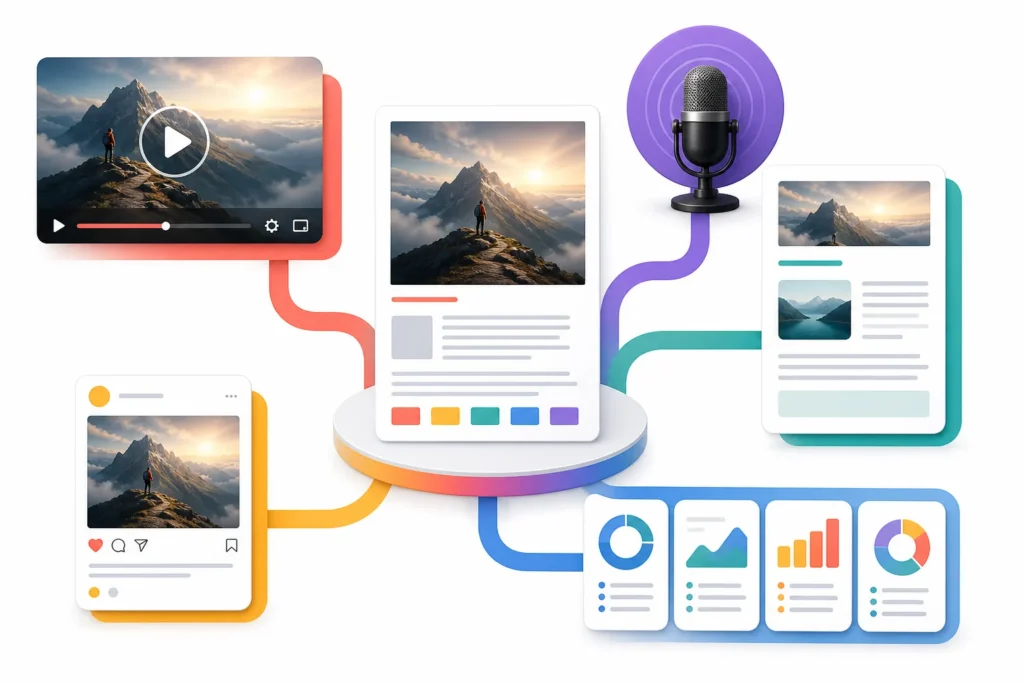
How to Repurpose One Piece of Content into a Full Month means adapting one pillar post, video, or podcast episode into channel-specific blog spin-offs, social posts, emails, visuals, and resources. One example from a pillar post includes 8–12 social posts, 2–4 videos or reels, four blog spin-offs, one email campaign, and one lead-generating resource.

  • A pillar-post example includes four blog spin-offs, 8–12 social posts, 2–4 videos or reels, one email campaign, and one lead-generating resource.
  • One YouTube video can become five to ten social media posts through clips, quotes, or standalone concepts.
  • A comprehensive blog post can fuel a five- to seven-email sequence when each email adds exclusive context.
  • A digital asset inventory can be a simple Excel worksheet or a Notion board.
  • Only about 10% of an audience may see a social post the first time it is shared.

How to Repurpose One Piece of Content into a Full Month: What does it mean to repurpose a piece of content, and how is it different from reposting it?

Content repurposing means using something you’ve already created in a new way. How to Repurpose One Piece of Content into a Full Month starts with adaptation, not duplication: you adjust the source message for different formats, platforms, and audience preferences instead of copying and pasting it.

Reposting keeps the same asset largely intact, while repurposing translates a core insight into a form suited to each audience and platform. That distinction matters for a content marketing strategy spanning website content, organic social channels, email newsletters, and visual assets. How to Repurpose One Piece of Content into a Full Month can therefore mean treating a published blog post, video, or podcast episode as source material for channel-specific derivatives.

The hub-and-spoke model is a useful planning metaphor: one central piece supplies ideas, while each channel receives a version shaped for its audience. How to Repurpose One Piece of Content into a Full Month is not mechanical duplication; it’s coordinated translation across your content workflow.

How to Repurpose One Piece of Content into a Full Month: What does it mean to repurpose a piece of content, and how is it

See the How To Repurpose One Piece Of Content Into A Full Month in detail.

How do you choose a source piece with enough useful ideas to support a month of content?

A strong source piece is usually a pillar post: an in-depth, evergreen work about a core audience topic with multiple subtopics, takeaways, or steps. For How to Repurpose One Piece of Content into a Full Month, choose material that solves a core audience problem, performs well, has a clear structure, and is timeless or easy to update.

Use traffic, search-intent alignment, and conversion data to identify high-value website content before you commit production time. Then break the candidate into statistics, quotes, frameworks, how-to steps, case studies, and conclusions. If the source doesn’t contain distinct ideas, How to Repurpose One Piece of Content into a Full Month becomes a forced exercise rather than a useful system.

Keep a content catalog with each blog post’s title, topic, live URL, resources, and lead magnets. A simple Excel worksheet or Notion board can serve as the digital asset inventory. Blog posts, video content, YouTube, podcast episodes, webinars, recorded workshops, how-to guides, and research reports can all work when they contain enough separate ideas. How to Repurpose One Piece of Content into a Full Month begins with evidence that the source has range.

How do you choose a source piece with enough useful ideas to support a month of content?

How many posts and content formats can one source piece realistically produce in a month?

One source can produce a substantial set of derivatives, but the available figures are examples and recommendations rather than a universal quota. A pillar-post example includes four blog spin-offs, 8–12 social posts, 2–4 videos or reels, one email campaign, and one lead-generating resource. How to Repurpose One Piece of Content into a Full Month should therefore be treated as a planning exercise, not a promise of identical output.

Another recommendation is to aim for at least distinct content assets from each flagship blog post. One YouTube video is described as producing five to ten social posts through clips, quotes, or standalone concepts. How to Repurpose One Piece of Content into a Full Month may also follow a video mix of five to six shorts, two carousels, three quote cards, two text posts, one newsletter section, and four comment answers.

A comprehensive blog post can support a five- to seven-email sequence when every email adds exclusive context. How to Repurpose One Piece of Content into a Full Month works best when you select only the formats your source and audience can genuinely support.

How many posts and content formats can one source piece realistically produce in a month?

What steps turn a blog post, video, or podcast episode into platform-specific social posts, emails, and visual assets?

An extraction document gives your content workflow a practical starting point: copy the source into a Google Doc or notes app, then map each idea to a possible format. How to Repurpose One Piece of Content into a Full Month becomes easier when every derivative has a job. A five-step video argument, for example, can become a five-card carousel.


Adapt each clip for its platform by changing the first frame, adding framing text, or moving the in-point. Short-form video needs a context-free hook and captions; one guide recommends a two-second hook, one claim or data point, two or three examples, and a call to action. How to Repurpose One Piece of Content into a Full Month can also turn a pillar post into a curated email summary, personal take, condensed version, or freebie.

Consider infographics, Stories graphics, carousels, podcast adaptations, blog conversions, and video walkthroughs. Add captions, transcripts, readable graphics, and descriptions of essential visual information when adapting video to audio. AI can assist with conversion, but human review is necessary because drafts may be inaccurate or robotic. How to Repurpose One Piece of Content into a Full Month still needs editorial judgment.

How should you schedule the repurposed pieces across a month without repeating the same message too often?

A 30-day calendar can place 8–12 social posts across two to four priority platforms instead of spreading effort across every channel. How to Repurpose One Piece of Content into a Full Month works better when you rotate angles from the same pillar post rather than repeat identical copy.

A practical sequence might begin with source promotion, move through educational derivatives, add visual assets and email content, and finish with a conversion-focused resource. Keep the recognizable brand voice and message while changing the format and framing. How to Repurpose One Piece of Content into a Full Month doesn’t require avoiding every repeated idea: expressing one useful idea in different formats on different platforms differs from posting the same clip repeatedly on the same surface.

Consider resurfacing carefully because one estimate says only about 10% of an audience may see a social post the first time. Organic social channels, email newsletters, website content, and longer-lived Pinterest posts can play different scheduling roles; Pinterest posts may live for years if done correctly. How to Repurpose One Piece of Content into a Full Month should give each derivative enough space to be noticed.

What tools and production time are needed to turn one source piece into a month of content?

A simple Excel asset inventory or Notion board can organize the source, derivatives, status, and review tasks. How to Repurpose One Piece of Content into a Full Month needs a visible production queue more than a complicated technology stack. Canva, Figma, and Adobe Express are named for visual assets, while CapCut, Descript, and Canva are described as beginner-friendly video tools.

Descript can help you find standalone moments by letting you read a video transcript. Transcript support can also help with old podcast episodes, including downloadable episode transcripts where the source provides them. How to Repurpose One Piece of Content into a Full Month can move faster when saved AI prompts reduce format-conversion time from hours to minutes.

Connect a blog CMS with social-scheduling and email tools so published material can queue drafts for human review. The available evidence doesn’t provide a universal production-time estimate. How to Repurpose One Piece of Content into a Full Month still requires professional editing, fact-checking, brand judgment, and audience-aware writing; AI and automation support that work rather than replace it.

How To Repurpose One Piece Of Content Into A Full Month

Learn more about the How To Repurpose One Piece Of Content Into A Full Month here.

What common repurposing mistakes reduce engagement, and how can you avoid them?

Random clip cutting is a common quality problem because equal time intervals can produce excerpts that depend on missing context and become incoherent alone. How to Repurpose One Piece of Content into a Full Month should rank candidate clips by the strength of their first three seconds, not only by the strength of the underlying idea.

AI-generated drafts also need human review because they can contain inaccuracies or sound robotic. Refresh, fact-check, and update older source content before republishing so it remains relevant. How to Repurpose One Piece of Content into a Full Month should preserve a consistent brand voice while changing the format and framing for each audience.

When spoken material becomes a blog post, use headers, sub-headers, bullet points, lists, and images instead of leaving a wall of text. Add captions and transcripts, use readable graphic design, and describe essential visual information. How to Repurpose One Piece of Content into a Full Month is strongest when accessibility and editorial clarity are treated as production requirements.

How To Repurpose One Piece Of Content Into A Full Month

Which performance metrics should you track to decide what to repurpose or improve next month?

Track each repurposed format separately, including website traffic, email signups, and LinkedIn connection requests where those analytics are available. How to Repurpose One Piece of Content into a Full Month needs a measurement framework that separates reach, engagement, traffic, conversions, and attribution rather than treating every reaction as equal.

Compare formats directly: reels may gain traction while quote graphics drive traffic. Comments and a video-retention graph can identify lines worth turning into quote cards or future derivatives. Immediate reactions and comments can also show what worked and what didn’t. How to Repurpose One Piece of Content into a Full Month should therefore produce learning, not merely more publishing.

End each month by asking what went well, what resonated, and what merits another round. Use available analytics to make adjustments where needed. How to Repurpose One Piece of Content into a Full Month is the kind of workflow Content Systems Desk can support by combining AI-assisted conversion with editing, fact-checking, human expertise, SEO content, email content, and brand-appropriate repurposing.

Find your new How To Repurpose One Piece Of Content Into A Full Month on this page.

Repurposing output counts by source (compiled from sources)
Source Input content Repurposing output
setfirecreative.com one pillar post four blog spin-offs, 8–12 social posts, 2–4 videos or reels, one email campaign…
marketingbyshelby.com one YouTube video five to ten social media posts
storyflow.so one video five to six shorts, two carousels, three quote cards, two text posts, a…
digitalapplied.com every flagship blog post at least distinct content assets
Input content Example output
One pillar post Four blog spin-offs; 8–12 social posts; 2–4 videos or reels; one email campaign; one lead-generating resource
One YouTube video Five to ten social media posts
One video Five to six shorts; two carousels; three quote cards; two text posts; one newsletter section; four comment answers
Every flagship blog post At least distinct content assets

Key Takeaways

  • Choose a structured, evergreen source that solves a core audience problem and contains multiple distinct ideas.
  • Extract statistics, quotes, frameworks, steps, case studies, and conclusions before choosing derivative formats.
  • Adapt hooks, captions, framing, length, and calls to action for each platform instead of copying the source.
  • Schedule 8–12 social posts across two to four priority platforms and rotate different angles.
  • Review format-level analytics monthly so the next round reflects audience response and available conversion data.

Frequently Asked Questions

What is the 5-3-1 rule on social media?

The claim ledger doesn’t define a 5-3-1 rule for social media, so its meaning is unknown here.

What is the 3-2-1 rule on Instagram?

The claim ledger doesn’t define a 3-2-1 rule for Instagram, so its meaning is unknown here.

Is content creation still worth it in 2026?

Whether content creation is still worth it in isn’t established by the claim ledger. The available evidence describes repurposing methods and output examples, not a universal business case.

What is the rule for social media?

The claim ledger doesn’t define the rule for social media, so its meaning is unknown here.

How To Build A Content Workflow That Scales Past One Writer

How to Build a Content Workflow That Scales Past One Writer means mapping stages from strategy and audience research through briefs, drafting, editing, design, approval, publishing, promotion, and measurement, then assigning clear owners and review rules. A RACI matrix, one final decision owner per asset, reusable templates, batching, and human review of AI-assisted drafts create a repeatable system for growing teams.

  • A content creation workflow defines the steps, responsibilities, timelines, and quality standards that move content from planning through distribution.
  • Lark’s Basic plan is listed at $6 per user per month when billed annually.
  • ONES Project’s free plan covers users, and paid plans start at $6 per user per month.
  • Wrike’s Team plan is listed at $9.80 per user per month and includes custom workflows and proofing.
  • Review turnaround time, revision-cycle count, and publishing-deadline adherence are workflow-efficiency measures.

How to Build a Content Workflow That Scales Past One Writer

How to Build a Content Workflow That Scales Past One Writer starts by defining the workflow as the steps, responsibilities, timelines, and quality standards that move content from planning through distribution.

How to Build a Content Workflow That Scales Past One Writer should connect content marketing strategy, audience research, content planning, content ideation, production, approvals, publishing, content promotion, and performance tracking.

How to Build a Content Workflow That Scales Past One Writer becomes practical when you map brainstorming, briefs, writing and drafting, editing, design and asset production, publishing, and promotion as visible workflow stages. Breaking the process into steps also shows which tasks can be outsourced without compromising quality.

For Content Systems Desk, that structure supports AI-assisted content creation, professional editing, fact-checking, humanizing drafts, long-form content, SEO content, email content, and content repurposing without treating automation as a substitute for judgment.

How To Build A Content Workflow That Scales Past One Writer

How should a team divide content roles and approval responsibilities when moving beyond one writer?

How to Build a Content Workflow That Scales Past One Writer requires explicit roles for writers, editors, AI tools, graphic designers, virtual assistants, content managers, subject matter experts, stakeholders, channel owners, and final approvers.

How to Build a Content Workflow That Scales Past One Writer is easier to manage with a RACI matrix that identifies who is responsible, accountable, consulted, and informed at each handoff. A content manager can lead the editorial calendar while freelance writers create copy and the manager proofreads and publishes it.

How to Build a Content Workflow That Scales Past One Writer should assign one named final decision owner to each asset; that person’s approval releases the asset for publication. Keep feedback separate from approval, apply approval to a specific file version, and archive earlier iterations through version control.

Documenting task ownership prevents a stakeholder’s comment from being mistaken for a publishing decision. The ledger does not identify a universal staffing ratio, so assign responsibility according to your actual workload and expertise.

What briefs, templates, calendar fields, and workflow tools are needed to make assignments repeatable, and what costs should a team budget for them?

How to Build a Content Workflow That Scales Past One Writer needs a content brief covering objectives, audience needs, tone, structure, deliverables, primary and secondary keywords, key points, and a proposed outline.

How to Build a Content Workflow That Scales Past One Writer should use reusable templates with titles, subtitles, introductions, main points, data, examples or case studies, paragraphs, and conclusions. Calendar fields should include date, channel, content, publishing time, title, and keywords.

How to Build a Content Workflow That Scales Past One Writer benefits from project-management features for task assignment, deadlines, stage tracking, custom fields, automation, forms, proofing, and approvals. Notion can hold SOPs and content calendars, Trello’s free plan includes up to boards, unlimited cards, and basic automation, CoSchedule supports workflow, calendar, scheduling, and publishing, and Editorial Calendar for WordPress lets teams schedule posts and see whether they are drafts or scheduled.

Listed prices vary: Lark’s Basic plan is $6 per user per month when billed annually, ONES Project has a free plan for users with paid plans from $6 per user per month, and Wrike’s Team plan is $9.80 per user per month. Budget separately for training, migration, productivity loss, and recurring platform fees.

How To Build A Content Workflow That Scales Past One Writer

How can a team plan and batch work to increase content output without creating bottlenecks between writers, editors, and approvers?

How to Build a Content Workflow That Scales Past One Writer uses batching to group similar tasks, such as researching and outlining several articles before drafting them.

How to Build a Content Workflow That Scales Past One Writer can follow a weekly pattern: research and outlines on Monday, drafting on Tuesday and Wednesday, editing and formatting on Thursday, and scheduling and promotion planning on Friday.

How to Build a Content Workflow That Scales Past One Writer needs review limits and deliberate sequencing. Review structure before polish, avoid parallel reviews that create conflicting instructions, and define approval layers to reduce delays.

As production increases, appoint a lead to manage the workflow and use automation for status transitions, assignments, and notifications. Capacity planning should include backlog prioritization, sprint planning, capacity planning, and retrospectives. A single review space supports asynchronous feedback, version control, and fewer repetitive comments.

How To Build A Content Workflow That Scales Past One Writer

Which content tasks are best suited to freelancers, in-house staff, or AI, and what quality or coordination trade-offs does each option bring?

How to Build a Content Workflow That Scales Past One Writer can use freelance SEO copywriters for blogs and landing pages that use SEO keywords. Evaluate candidates through a limited paid trial or sample post to assess professionalism and their response to feedback.

How to Build a Content Workflow That Scales Past One Writer should account for the trade-off between writing services and direct hiring: services cost more per piece, while direct hiring costs less per piece but leaves hiring and management work with your team.

How to Build a Content Workflow That Scales Past One Writer keeps calendars, proofreading, publishing, fact-checking, brand voice, readability, and rich media with in-house managers or editors where those responsibilities require close coordination.

AI can support brainstorming, angles, headlines, outlines, first drafts, keyword research, research summaries, metadata, and social posts, but the output should be treated as a rough draft. A hybrid workflow uses people for insight, fact verification, and brand voice; human editing remains necessary because AI can produce inaccurate claims. Published posts can also be repurposed into social content, while AI can identify outdated statistics or suggest sections for older posts.

How To Build A Content Workflow That Scales Past One Writer

What review steps and standards help maintain accuracy, brand voice, and compliance as more people produce content?

How to Build a Content Workflow That Scales Past One Writer needs a style guide covering tone of voice, vocabulary, grammar, formatting, visual guidance, and calls to action.

How to Build a Content Workflow That Scales Past One Writer should give new contributors brand examples, guidelines, templates, a one-page intake brief, and a short walkthrough of the intake form. That onboarding system makes the brand voice and task requirements available before drafting begins.

How to Build a Content Workflow That Scales Past One Writer should sequence self-editing, grammar checking, fresh-eyes review, subject matter expert review, stakeholder review, compliance review, final sign-off, and publication. Review claims, statistics, originality, accuracy, readability, errors, and brand alignment, especially in AI-generated content.

Classify incoming assets by risk: high-risk assets go through the full review workflow, while low-risk assets can receive a single reviewer sign-off. Intake should require an approved brief, brand-guideline reference, asset specifications, legal disclosures, deadline, and publish date.

Which metrics, such as production time, cost per asset, revision rate, and publishing volume, show whether the workflow is scaling successfully?

How to Build a Content Workflow That Scales Past One Writer should begin with production time: record how long each part of content creation takes for a week in a spreadsheet or free time-tracking app.

How to Build a Content Workflow That Scales Past One Writer should track review turnaround time, revision-cycle count, and adherence to publishing deadlines as workflow-efficiency indicators. Add cost per asset, staffing or tool costs, revision rate, and publishing volume as practical operating measures. The ledger provides no fixed benchmark for acceptable values.

How to Build a Content Workflow That Scales Past One Writer must distinguish output from impact. Track publishing volume alongside traffic, engagement, conversion rates, and content-refresh frequency. Workflow tools may also report burndown, velocity, and cumulative flow.

Review these measures on a regular cadence and use the results to adjust capacity, bottlenecks, outsourcing, AI assistance, and approval rules. The ledger does not provide a universal scaling threshold, so a successful workflow is one that your measurements show is becoming more manageable without weakening quality.

How To Build A Content Workflow That Scales Past One Writer

Check out the How To Build A Content Workflow That Scales Past One Writer here.

Listed content and project workflow tool prices (per stated billing unit) (compiled from sources)
Product Listed plan or offer Listed price
Lark Basic plan; for up to users $6 per user per month when billed annually
Jasper Pro plan $59 per month per seat when billed annually
Copy.ai Chat plan; for five seats $29 per month for five seats
ONES Project Free plan; paid plans Free plan covers users, and paid plans start at $6 per user per month
Wrike Team plan; includes custom workflows and proofing $9.80 per user per month

Key Takeaways

  • Map every stage from ideation through distribution and make each handoff visible.
  • Use a RACI matrix and one named final decision owner for each asset.
  • Standardize briefs, templates, calendar fields, intake requirements, and version control.
  • Batch similar work, sequence structural review before polish, and monitor capacity.
  • Treat AI output as a rough draft and reserve human review for facts, insight, readability, and brand voice.

Frequently Asked Questions

What is a content production workflow?

A content production workflow is the steps, responsibilities, timelines, and quality standards that move content from planning through distribution. It can cover strategy, ideation, production, approvals, publishing, promotion, and performance tracking.

What is the/20 rule for blogging?

The ledger does not define an/20 rule for blogging. It does describe a hybrid AI workflow in which AI handles repetitive work while people focus on insight, fact verification, and brand voice.

How do I start content writing?

Start content writing with strategy, audience research, content ideation, keyword research, and a brief that defines objectives, audience needs, tone, structure, deliverables, and an outline.

What are the four types of workflows?

The ledger does not identify four types of workflows. It does identify workflow stages including strategy, ideation, production, approvals, publishing, promotion, and performance tracking.

How To Write Email Content That Doesn’t Sound Like AI Wrote It

AI writing tools can help you create human-sounding email content when you provide audience, purpose, verified context, and brand voice, then edit the draft for specificity and accuracy. How to Write Email Content That Doesn't Sound Like AI Wrote It also means keeping cold emails concise: a message longer than words may be too long.

  • A cold email longer than words may be too long.
  • A useful AI email prompt can include the audience, goal, channel, brand voice, words to use or avoid, and desired length.
  • Generic cold emails are reported at roughly 9% response rates, compared with about 18% for advanced personalized emails.
  • AI-generated claims should be checked against reliable sources, including names, dates, and statistics.
  • Three to five strong-performing emails from the past months can serve as voice samples.

How to Write Email Content That Doesn't Sound Like AI Wrote It

How to Write Email Content That Doesn't Sound Like AI Wrote It starts with spotting generic introductions, stiff transitions, and vague promises, which are telltale signs of AI-written copy. Polished but lifeless language can include “I hope this email finds you well,” vague claims about synergy, fake compliments, filler openers, corporate filler, and empty intensifiers.

How to Write Email Content That Doesn't Sound Like AI Wrote It also means checking rhythm. AI drafts may repeat sentence structures, begin paragraphs with phrases such as “It is important to,” overuse “Furthermore” or “Moreover,” hedge with “it would seem that,” and avoid contractions such as “don't” and “it's.”

How to Write Email Content That Doesn't Sound Like AI Wrote It requires restraint as well as personality. For cold email outreach, a message longer than words may be too long. Keep the reason for writing visible, remove padded language, and make the value relevant to the recipient rather than relying on generic warmth.

How to Write Email Content That Doesn't Sound Like AI Wrote It

Learn more about the How To Write Email Content That Doesnt Sound Like AI Wrote It here.

What information should you give AI before asking it to draft an email?

AI-assisted email writing improves when your prompt defines the audience, purpose, channel, brand voice, words to use or avoid, and desired length. Start by naming the email’s purpose and recipient, then add its topic, desired tone, and length.

How to Write Email Content That Doesn't Sound Like AI Wrote It depends on giving the tool a clear job to be done. For a reply, specify the desired outcome, the constraint that must remain, the appropriate warmth for the relationship, and the recipient’s next action. For a new message, a prompt can ask the tool to sound like you, address a specific type of person, and explain why the email is being sent.

How to Write Email Content That Doesn't Sound Like AI Wrote It can also begin with three sentences about the subject written as if you were texting a friend. Add actual customer phrases, brand-specific phrases, or metaphors to ground the draft in real-world language. Those details support audience research without asking the tool to invent emotional depth or personal history.

What information should you give AI before asking it to draft an email?

How can you prompt AI to write in a specific human voice without inventing personal details?

Human-sounding content needs voice instructions that describe behavior, not just adjectives. Tone anchors such as “a friendly shop owner” can reduce stiff and formal language. Ask for contractions, short sentences, appropriate fragments, varied sentence lengths, and specific examples instead of abstract statements.

How to Write Email Content That Doesn't Sound Like AI Wrote It works better when the voice comes from evidence. Give the tool real sent emails and ask it to identify opening habits, sentence length, sign-off patterns, and phrases you avoid. A reusable profile can describe how you open, compress context, soften disagreement, close, and reject phrases you wouldn't send.

How to Write Email Content That Doesn't Sound Like AI Wrote It doesn't mean accepting the first output. Request several options, then mix, match, and rewrite them rather than copying one as-is. Personal details should come from supplied or verified context, and sensitive information shouldn't be shared with AI tools.

How can you prompt AI to write in a specific human voice without inventing personal details?

How to Write Email Content That Doesn't Sound Like AI Wrote It: What should you revise first?

AI-generated email copy should be treated as a first draft rather than sent without editing. How to Write Email Content That Doesn't Sound Like AI Wrote It starts with structure: review the overall flow before correcting small issues such as commas. Make the reason for the email obvious within its first few lines.

How to Write Email Content That Doesn't Sound Like AI Wrote It becomes practical during the line edit. Remove clichés, replace vague claims with concrete details, add a specific story or example, and use your usual sign-off. Cut filler, add context, replace general claims with real reasons, and read the email aloud. Break sentences containing multiple commas and clauses into shorter sentences, then read the revision aloud again to catch awkward phrasing and unnatural rhythm.

For cold email outreach, a human-sounding structure can use three or four short paragraphs, one ask, specificity, and an honest reason for reaching out. That gives the recipient a concise message with one clear call to action instead of several competing requests.

How to Write Email Content That Doesn't Sound Like AI Wrote It: What should you revise first?

How can you personalize an email with verified recipient details without making it feel intrusive or fake?

Personalization should refer to real, observed recipient details rather than merely inserting a first name into a template. How to Write Email Content That Doesn't Sound Like AI Wrote It therefore starts with verified context and a specific customer problem, not superficial familiarity.

How to Write Email Content That Doesn't Sound Like AI Wrote It can be applied at the segment level. Recipient groups may distinguish new from repeat customers or first-time from recurring donors. For developer outreach, possible sources include a maintained repository, programming language, filed issue, or written tutorial. An email sequence can use a lead’s actual bio, company, and topics, then apply a voice persona and remove banned words.

How to Write Email Content That Doesn't Sound Like AI Wrote It also separates facts from style: tool access supplies factual context while a voice profile shapes how the email sounds. The reported comparison is roughly 9% response for generic cold emails and about 18% for advanced personalized emails; about 5% of senders personalize every message. Avoid sharing sensitive information with AI tools.

Discover more about the How To Write Email Content That Doesnt Sound Like AI Wrote It.

What risks come from overediting an AI draft, and how can you check its accuracy and tone before sending?

Users remain responsible for reviewing and editing the final email before sending it. How to Write Email Content That Doesn't Sound Like AI Wrote It requires balance: overediting can flatten a useful draft, while underediting can leave incorrect details or context-inappropriate phrasing. Check accuracy, tone, and completeness before making edits and sending.

How to Write Email Content That Doesn't Sound Like AI Wrote It also requires fact-checking. Check every AI-generated claim against reliable sources, including names, dates, and statistics, because AI can confidently provide outdated or incorrect information. Don't let AI invent beneficiary stories or donor testimonials, and check generated statistics against reputable sources with real publication dates.

How to Write Email Content That Doesn't Sound Like AI Wrote It should sound like something you would say to a stranger, not a press release; read it aloud and rewrite it if necessary. Before sending, preview images, preview text, and personalization fields, checking that nothing feels automated or off-brand. You can also ask an AI tool to respond as the recipient and explain whether the email sounds AI-generated and why. The supplied evidence doesn't establish specific deliverability, spam-filter, sender-reputation, or legal-compliance requirements.

How can you keep a consistent human voice across a large email campaign while using AI?

Large email marketing campaigns need a reusable voice system, not a new instruction set for every draft. How to Write Email Content That Doesn't Sound Like AI Wrote It can begin with three to five strong-performing emails from the past months as voice samples. Ask AI to analyze their tone, sentence length, common phrases, and overall feel, then summarize the brand voice in bullets.

How to Write Email Content That Doesn't Sound Like AI Wrote It stays consistent when you save that summary as a reusable voice profile. Add a format-specific layer because email voice can differ from long-form voice in pacing, paragraph length, and structural habits. A saved voice persona, banned-word list, and human editing step can keep generated emails in character and free of filler.

How to Write Email Content That Doesn't Sound Like AI Wrote It also includes campaign feedback. Repeat the same core promise, offer or impact phrase, and selected turns of phrase across assets. Feed open rates, click-throughs, and survey responses into future prompts, and observe who opens, replies to, or ignores cold emails. Keep email tone aligned with the writer’s voice on platforms such as LinkedIn and podcasts to avoid breaking trust. Content Systems Desk’s focus on AI content editing and professional human expertise fits that workflow: AI drafts, while people check accuracy, usefulness, originality, and brand voice.

How To Write Email Content That Doesn't Sound Like AI Wrote It

Discover more about the How To Write Email Content That Doesnt Sound Like AI Wrote It.

Reported cold-email response rates (compiled from sources)
Email type Reported response rate
generic cold emails roughly 9% response rates
advanced personalized emails about 18%
Signal-personalized emails 18–35% response rates

Key Takeaways

  • Give AI a defined audience, purpose, tone, length, and words to use or avoid.
  • Use verified recipient details and real customer language instead of superficial personalization.
  • Treat every AI email as a first draft and revise structure, specificity, rhythm, and sign-off.
  • Check names, dates, statistics, personalization fields, tone, and completeness before sending.
  • Maintain a reusable voice profile and feed campaign engagement metrics into future prompts.

Frequently Asked Questions

How to make emails not sound like AI?

Make emails sound less like AI by supplying a clear audience, purpose, tone, length, and real language, then editing the draft for specificity and natural rhythm. AI output should be treated as a first draft, not sent unchanged.

How to ensure your writing doesn't sound like AI?

Use contractions, varied sentence lengths, specific examples, and a voice profile based on real sent emails. Remove filler, vague claims, and formal transitions, then read the revised email aloud.

How to make something sound like it wasn't written by AI?

Give the tool verified context and your actual voice patterns, then mix and rewrite multiple draft options instead of copying one. Personal details should come from supplied or verified context.

How to reword something so it doesn't sound like AI?

Reword an AI draft by cutting filler, replacing vague claims with real reasons and concrete details, shortening overlong sentences, and using your usual sign-off. Read the revision aloud to catch unnatural phrasing.

Ghostwriting Cost: What To Budget For Quality Work

Ghostwriting costs range from per-word and hourly rates to project fees: listed rates run from $0.50 to $5 per word, while experienced or specialized ghostwriters may charge $125–$200 or more per hour. Ghostwriting Cost: What to Budget for Quality Work means comparing scope, research, revisions, rights, deadlines, and deliverables—not just the headline price.

  • Typical book-contract inclusions can include research, interviews, outlining, a full manuscript draft, 2–3 revision rounds, and basic submission formatting.
  • Ghostwriters generally charge $0.50 to $5 per word, with business-book ghostwriters often toward the higher end.
  • Hourly ghostwriting rates are listed at $50–$75 for junior writers and $125–$200 or more for experienced or specialized writers.
  • Moderate research may add 10–20%, while heavy research may add 25–50%.
  • Ghostwriting payments are typically milestone-based rather than fully upfront.

What does a ghostwriting project typically include, and which services are billed separately?

A ghostwriting project can cover the path from developing an idea to producing a finished manuscript, rather than writing alone. Research may include books, articles, interviews, and primary-source materials. For a typical book contract, you may see initial research and interviews, outline development, a full manuscript draft, 2–3 revision rounds, and basic formatting for submission.

Ghostwriting Cost: What to Budget for Quality Work depends partly on where that scope ends. Professional line editing, proofreading, cover design, ISBN and publishing logistics, and marketing strategy are usually outside the ghostwriting fee. Business ghostwriting can cover blog posts, ebooks, or business books while you retain writing credit. Ghostwriting Cost: What to Budget for Quality Work should therefore be read as a scope question, not just a writing-price question. For Content Systems Desk readers managing AI-assisted content, ask whether human research, fact-checking, editing, and brand alignment are included. Ghostwriting Cost: What to Budget for Quality Work becomes easier to assess when every deliverable is named.

What does a ghostwriting project typically include, and which services are billed separately?

Check out the Ghostwriting Cost: What To Budget For Quality Work here.

Ghostwriting Cost: What to Budget for Quality Work

Ghostwriters may charge per word, per hour, or by flat project fee, so the same manuscript can produce very different-looking quotes. Typical hourly rates are listed at $50–$75 for junior ghostwriters, $75–$125 for mid-level writers, and $125–$200 or more for experienced or specialized writers.

Per-word rates generally range from $0.50 to $5, with business-book ghostwriters often toward the higher end. Basic ghostwriting based on interviews or notes is listed at $20,000–$60,000 or more. One writer reports charging $1 per word and $300 per hour for coaching or consulting. Ghostwriting Cost: What to Budget for Quality Work should show which pricing method you’re comparing. Ghostwriting Cost: What to Budget for Quality Work also requires checking whether research, revisions, and project management sit inside the quoted figure. For AI-assisted workflows, compare the human work promised, not merely the unit rate. Ghostwriting Cost: What to Budget for Quality Work is clearest when the quote ties payment to defined work.

Ghostwriting Cost: What to Budget for Quality Work

How do ghostwriting rates vary by format, such as books, memoirs, articles, and speeches?

Ghostwriting rates vary sharply by format, audience, complexity, and writer experience. For a 50,000–70,000-word nonfiction book, listed prices run from $15,000–$35,000 for entry-level writers to $75,000–$150,000 or more for experienced writers. Memoirs range from $20,000–$50,000 for personal or family-only projects to $100,000–$500,000 or more for celebrity memoirs.

Articles and blog posts of 1,000–5,000 words are listed at $500–$2,000 for low complexity and $5,000–$15,000 for high complexity. Short speeches of 600–1,200 words are listed at $1,500–$5,000, while conference keynotes are listed at $10,000–$55,000 or more. Ghostwriting Cost: What to Budget for Quality Work should be matched to the format in the proposal. Ghostwriting Cost: What to Budget for Quality Work can’t be inferred from word count alone. Ghostwriting Cost: What to Budget for Quality Work is more useful when you compare scope as well as price.

How do ghostwriting rates vary by format, such as books, memoirs, articles, and speeches?

Which factors most affect the price of a ghostwriting project, including length, research, and deadline?

Project length, complexity, research, experience, scope, and deadline all influence a ghostwriting quote. Flat fees may be based on estimated word count, content complexity, and the ghostwriter’s experience. Costs can also depend on content type, research needs, images, and hyperlinks.

Research premiums can be substantial: moderate research may add 10–20%, heavy research 25–50%, and extremely research-intensive work 50–100% or require additional researchers. An expedited six-to-eight-week book timeline may add a 10–25% premium; four weeks or less may add 25–50% or be refused. One author usually asks clients to allow a year for a book, although some projects finish months sooner. Ghostwriting Cost: What to Budget for Quality Work should account for the evidence-gathering burden. Ghostwriting Cost: What to Budget for Quality Work also needs a realistic schedule. Ghostwriting Cost: What to Budget for Quality Work is incomplete if the deadline premium is hidden.

Which factors most affect the price of a ghostwriting project, including length, research, and deadline?

How can you request a detailed ghostwriting quote and compare proposals from different writers?

A detailed ghostwriting request should define your format, audience, destination, realistic timeline, and available budget before you contact writers. Ask each candidate for a written estimate that lists inclusions and exclusions, then clarify the cost of revision overages.

Compare interview sessions, outline coverage, draft count, and revision rounds rather than comparing only the headline total. Ghostwriting Cost: What to Budget for Quality Work is easier to compare when every proposal uses the same brief. Review work samples and interview applicants when hiring directly. Unexplained rate variation and lump-sum proposals without payment schedules tied to deliverables are warning signs. Ghostwriting Cost: What to Budget for Quality Work should make the work visible before you sign. Ghostwriting Cost: What to Budget for Quality Work is also a practical brief for Content Systems Desk readers evaluating human writers alongside AI-assisted production workflows.

Get your own Ghostwriting Cost: What To Budget For Quality Work today.

What extra costs or contract terms should you budget for, such as revisions, research, and usage rights?

Extra costs often arise when a low base price excludes revisions, editing, cover design, or marketing. A flat fee can instead be paired with milestone payments, defined deliverables, and stated revision rounds. Your contract should specify interview sessions, whether an outline is included, and how many drafts and revision rounds the fee covers.

Rights also matter: the price can depend on whether you purchase full rights or limited usage rights. Payments are typically milestone-based rather than fully upfront. Publishing, design, marketing, and sales-funnel costs may belong in the wider book budget. Ghostwriting Cost: What to Budget for Quality Work should include these terms, not just manuscript production. Ghostwriting Cost: What to Budget for Quality Work is safer when overages are written down. Ghostwriting Cost: What to Budget for Quality Work should leave no uncertainty about who pays for added research or revisions.

Ghostwriting Cost: What To Budget For Quality Work

How can you assess whether a ghostwriter’s quote offers good value before hiring them?

A ghostwriter’s quote offers stronger value when it sits within the market range, shows the all-in cost clearly, avoids hidden fees, and fits the project scope. For a business, marketing team, blogger, founder, agency, or content team, the relevant question is whether the writer can deliver accurate, original, brand-appropriate work within the defined brief.

Individual freelance talent can vary, while some companies provide multi-layer quality checks and project management. Compare samples, interviews, defined deliverables, revision terms, and milestone payments consistently. A proposal should explain rate variation rather than present an unexplained lump sum. Ghostwriting Cost: What to Budget for Quality Work is therefore a scope-and-quality assessment. Ghostwriting Cost: What to Budget for Quality Work should guide your questions about human editing, fact-checking, and brand fit when AI-assisted drafts are part of your workflow. Ghostwriting Cost: What to Budget for Quality Work is valuable only when the quoted work supports the outcome you need.

Check out the Ghostwriting Cost: What To Budget For Quality Work here.

Book ghostwriting prices (USD) (compiled from sources)
Source and book scope Stated price
laurasherman.com — a book that is 200–300 pages long $50,000–$75,000
stellarcontent.com — business ghostwriting per book starts at $5,000 per book
authorsunite.com — basic ghostwriting only, based on interviews or notes $20,000–$60,000+
vocal.media — books $10,000 to $100,000 or more
connectedghostwriting.com — 50,000–70,000-word nonfiction books, entry-level… $15,000–$35,000
connectedghostwriting.com — 50,000–70,000-word nonfiction books, mid-level… $35,000–$75,000
connectedghostwriting.com — 50,000–70,000-word nonfiction books, experienced… $75,000–$150,000 or more
Ghostwriting rates per word (USD) (compiled from sources)
Source and category Stated per-word rate
laurasherman.com — usual charge one dollar per word
stellarcontent.com — business ghostwriting $1 to $3
stellarcontent.com — entry-level writers; simple blogs and general web content 5–10 cents per word
authorsunite.com — ghostwriters generally $0.50 to $5 per word
Format and scope Listed price Category Claim key
50,000–70,000-word nonfiction book $15,000–$35,000 Entry-level writer c_0049
50,000–70,000-word nonfiction book $35,000–$75,000 Mid-level writer c_0049
50,000–70,000-word nonfiction book $75,000–$150,000 or more Experienced writer c_0049
Personal or family-only memoir $20,000–$50,000 Memoir format c_0050
Public-audience memoir $40,000–$100,000 Memoir format c_0050
Celebrity memoir $100,000–$500,000 or more Memoir format c_0050
1,000–5,000-word article or blog post $500–$2,000 Low complexity c_0051
1,000–5,000-word article or blog post $5,000–$15,000 High complexity c_0051
Short speech of 600–1,200 words $1,500–$5,000 Short speech c_0052
Conference keynote speech $10,000–$55,000 or more Keynote c_0033

Key Takeaways

  • Define the format, audience, destination, timeline, and available budget before requesting proposals.
  • Ask for inclusions, exclusions, deliverables, revision overages, rights, and payment milestones in writing.
  • Compare research demands and deadline premiums as carefully as the writing fee.
  • Use samples and interviews to assess individual talent, then compare the quality controls and project management offered.
  • Judge value by all-in scope and brand fit rather than by the lowest quoted price.

Frequently Asked Questions

How much do ghostwriters charge per word, per hour, or per project?

Ghostwriters may charge $0.50 to $5 per word, $50–$200 or more per hour depending on experience, or a flat project fee. Basic ghostwriting based on interviews or notes is listed at $20,000–$60,000 or more.

How much does it cost to ghostwrite a book?

Book ghostwriting for a 50,000–70,000-word nonfiction book is listed at $15,000–$35,000 for entry-level writers and $75,000–$150,000 or more for experienced writers.

What factors affect ghostwriting cost?

Research, word count, complexity, experience, project scope, and turnaround can affect ghostwriting prices. Moderate research may add 10–20%, while heavy research may add 25–50%.

How should you compare ghostwriting proposals?

Ask for a written estimate listing inclusions, exclusions, deliverables, payment milestones, and revision overages. Review samples and interview applicants before hiring directly.

What should a ghostwriting contract include?

Contracts should specify interview sessions, outline coverage, draft count, revision rounds, rights, and payment milestones. Publishing, design, marketing, and sales-funnel costs may sit outside the writing fee.

How To Build A Content Workflow That Scales Past One Writer

A scalable content workflow helps Content Systems Desk coordinate writers, editors, reviewers, designers, SEO specialists, and publishing teams through defined stages, handoffs, automation, and human approval. A nine-stage path can run from idea capture and prioritization through briefing, drafting, editing, approval, publishing, distribution, and measurement [1]. The system increases output without sacrificing relevance, voice, or performance [2].

  • A scalable content workflow uses structured inputs, defined roles, stages, quality checks, and measurement feedback loops [3].
  • A documented workflow can include nine stages from idea capture through measurement [1].
  • AI-assisted drafts should receive human review before publishing and should not be published as-is [4].
  • Lark’s Basic plan is priced at $6 per user per month when billed annually and supports up to users [5].
  • Workflow performance measures include monthly writer output, idea-to-post time, and active campaign projects [6].

What is a scalable content workflow, and how does it differ from a process managed by one writer?

A content workflow is a set of pre-established steps for creating, reviewing, and delivering content [7]. A scalable content production process turns those steps into an end-to-end operating system with structured inputs, defined roles, stages, quality checks, and measurement feedback loops [3].

A solo writer may combine planning, briefing, and drafting in one session, with fewer approval stages and more flexibility [1] [5]. A team workflow instead makes handoffs visible: a strategist or coordinator can prepare the input, a writer can draft, an editor can improve the piece, and a reviewer can approve it. Scaling means increasing output sustainably without sacrificing relevance, voice, or performance [2].

For Content Systems Desk, the useful model combines AI-assisted production with professional editing and human expertise. AI can assist with drafting, editing suggestions, metadata, and optimization, but human oversight remains necessary for accuracy and quality [5].

Create a polished editorial illustration of a scalable content workflow: multiple connected gears, cards, and branching paths moving from idea to publ...
Create a polished editorial illustration of a scalable content workflow: multiple connected gears, cards, and branching paths moving from id…
A polished editorial illustration of a modular content-production conveyor system: organized stages, branching pathways, approval checkpoints, quality...
A polished editorial illustration of a modular content-production conveyor system: organized stages, branching pathways, approval checkpoint…

Check out the How To Build A Content Workflow That Scales Past One Writer here.

Which stages and handoffs should a content workflow cover from topic selection through publishing and distribution?

A complete content workflow should cover planning, production, and publishing [3]. One useful nine-stage path is idea capture, prioritization, briefing, drafting, editing, approval, publishing, distribution, and measurement [1].

Define the handoffs between research and ideation, drafting and generation, editing and optimization, and distribution and repurposing [8]. Content planning should connect audience needs and business goals with content ideation, keyword mapping, SEO, organic search, and the editorial calendar; brainstorming generates ideas, while keyword mapping connects topics to discoverability and long-term value [5].

Where applicable, add legal or compliance review, brand approval, scheduling, CMS publishing, cross-channel distribution, and post-publish QA [1]. Treat briefs and drafts as content assets: shared access, simultaneous editing, change tracking, and version control help maintain one reliable working record [8].

A polished editorial illustration of a color-coded workflow map made from connected cards, arrows, and checkpoints arranged from idea bulb to publishi...
A polished editorial illustration of a color-coded workflow map made from connected cards, arrows, and checkpoints arranged from idea bulb t…

How do task-based and status-based workflows differ, and which is better for coordinating multiple writers and reviewers?

Task-based workflows define what must be done, who is responsible, and when each step is due [7]. That structure suits larger teams and complex projects with multiple stakeholders [7]. You can assign keyword research, drafting, editing, design coordination, review, and final QA as separate tasks, then use project-management software to set deadlines and track statuses [7].

Status-based workflows organize shared progress labels such as “Brief ready,” “Draft in progress,” “In editorial review,” and “Ready to publish” [8]. They may be more efficient for small teams or simple projects that need less detailed direction at each step [7].

Neither model is universally better. Match the model to complexity and interdependencies: task-based workflows suit clearly defined steps, while status-based workflows suit projects with complex interdependencies and multiple contributors [6]. For multiple writers and reviewers, combine clear task ownership with shared content status tracking when both accountability and visibility matter.

How To Build A Content Workflow That Scales Past One Writer

What roles, decision rights, and approval steps should be defined to prevent bottlenecks as the team grows?

Content teams should define roles for strategy, ideation, writing, editing, design, distribution, SEO, coordination, legal review, and development where needed [7] [6]. Give every workflow stage one accountable owner and a clear definition of done [1]. A RACI matrix records who is responsible, accountable, consulted, and informed across roles and handoffs [5].

Separate editing from quality assurance: editing improves a piece, while QA enforces standards [3]. When several people can approve a stage, name a final decider so feedback doesn’t create an indefinite queue [1]. Document review cycles, permitted edit rounds, participants, failure modes, escalation criteria, and human override points for AI outputs [3] [5].

Set service-level expectations for review turnaround as an operational standard. The ledger provides no universal turnaround target, so your team must define a target that fits its workload, deadlines, and approval risk.

Which briefs, templates, and quality checklists should be standardized, and where should writers retain flexibility?

Standardize the content brief before production begins. A useful brief includes a working title, summary, suggested angles, format type, audience, and intended outcome [9], then adds the unique angle, required sources, internal links, objectives, tone, structure, and deliverables [1] [5].

Use structured inputs and prompt standardization for AI-assisted work: provide clear constraints, relevant examples, and specific instructions about what to include and avoid [3]. Standardize brand voice, accuracy, compliance, brand alignment, SEO elements, formatting, claim support, scannability, and logic flow through review and self-edit checklists [3] [1].

Leave room for a writer’s personality, expertise, creative approach, and illustrative examples when the core constraints are met [10] [3]. Make briefs and brand guidelines available at the start, with QA checks and review checkpoints throughout [6]. Shared access, change tracking, and version control should make the brief and draft the single source of truth [8].

Which parts of content production can be automated, and which require human review to manage accuracy and brand risks?

Workflow automation is best suited to repetitive administrative work, content templates, status notifications, metadata, auto-tagging, repeated fields, scheduled social posts, repurposing, and distribution [9] [7] [1] [2]. Project tools can also provide automated status tracking, giving teams real-time visibility and reducing repetitive communication [5].

AI and large language models can support article planning, outlines, draft paragraphs, editing, optimization, metadata, and identifying visual opportunities [3] [4]. Human review remains necessary for factual accuracy, claims verification, brand tone, strategic alignment, legal sign-off, insight, judgment, and the final publish decision [3] [1] [8] [2]. AI-assisted drafts should receive editorial review and should not be published as-is [4].

Test an automated workflow with at least to submissions before wider use [9]. Human approval protects content quality, brand voice, SEO judgment, and accuracy while automation reduces repetitive work [9] [6].

Get your own How To Build A Content Workflow That Scales Past One Writer today.

What staffing, software, and production-capacity requirements determine the cost of scaling a content workflow?

Production frequency should follow team bandwidth and business goals rather than an assumed publishing quota [7]. Plan staffing around the stages and roles required for strategy, writing, editing, design, SEO, coordination, review, publishing, and distribution [8] [6]. Review current projects and workloads before adding requests so writing-project planning remains realistic and supports workload balancing [11].

Project-management software can assign work, set deadlines, and track content statuses, while file-sharing platforms provide a secure shared space for collaborative drafting [7]. Writers and collaborators need to be capable users of the technologies that support the process [12]. Document the process and train new contributors on briefs, brand voice, handoffs, review, and publishing requirements.

Workflow planning can forecast financial and human resources at each stage [6]. Lark’s Basic plan is priced at $6 per user per month when billed annually and supports up to users [5]. A complete cost model for staffing, outsourcing, software, and production capacity is unknown from the available evidence.

How To Build A Content Workflow That Scales Past One Writer

Which metrics can reveal whether the workflow is improving throughput, turnaround time, and content quality?

Measure cycle time with brief-to-publish days, idea-to-post time, approval-cycle time, review turnaround time, and adherence to publishing deadlines [1] [5] [6]. Measure throughput with monthly writer output, content volume per writer, and the number of active projects in a campaign [8] [6]. On-time publish rate adds a scheduling view.

Track revision-cycle count and investigate when content consistently needs more than two revision rounds, because that pattern can indicate a problem with the initial brief or review stage [10]. Measure outcomes through organic traffic, engagement, conversions, traffic, refresh frequency, outcomes per piece, and content reuse rate [1] [5] [3].

Review workflow outputs daily during the first week, make small changes in a 15-minute weekly review, and hold broader quarterly reviews for bottlenecks and solutions [9] [1] [10]. Team adoption and performance at each workflow stage show whether the standardized process is being used and where it needs attention [9] [4].

Discover more about the How To Build A Content Workflow That Scales Past One Writer.

Content workflow measures by source (compiled from sources)
Source Workflow measures stated
linkedin.com [9] how much faster content moves from idea to publication; whether members are usin [9]
rewritebar.com [1] brief-to-publish days, on-time publish rate, approval-cycle time, organic and en [1]
larksuite.com [5] review turnaround time, revision-cycle count, and adherence to publishing deadli [5]
brafton.de [6] monthly writer output, idea-to-post time, and the volume of active projects for [6]

Key Takeaways

  • Give every workflow stage one accountable owner and a clear definition of done [1].
  • Use structured briefs, prompt constraints, brand guidance, and publishing checklists to reduce avoidable rework [3] [5].
  • Automate repetitive administrative work, but keep accuracy, claims verification, brand tone, legal sign-off, and final publishing human-gated [1].
  • Match task-based or status-based coordination to project complexity and contributor interdependencies [6].
  • Track cycle time, revision count, throughput, adoption, reuse, and content outcomes, then review the process at daily, weekly, and quarterly intervals [9] [1] [10].

Frequently Asked Questions

Is content creation still worth it in 2026?

The provided evidence doesn’t establish whether content creation remains worthwhile in 2026. It does show that a documented workflow can help teams increase content volume while maintaining consistency, and that performance should be measured through outcomes such as organic traffic, engagement, conversions, and reuse rate [4] [1].

How to scale content creation?

Scale content creation by defining stages, owners, briefs, review checkpoints, automation boundaries, capacity, and performance measures. A scalable workflow uses structured inputs, defined roles, quality checks, and feedback loops rather than relying on one writer’s individual process [3].

What are the steps of workflow?

A practical five-part workflow can cover planning, briefing, production, review and approval, and publishing and distribution. The ledger also describes a nine-stage path: idea capture, prioritization, briefing, drafting, editing, approval, publishing, distribution, and measurement [3] [1].

What are the steps of content creation?

The evidence does not define one universal seven-step content-creation model. One documented collaborative-writing model identifies brainstorming, conceptualizing, outlining, drafting, reviewing, revising, and editing as seven core activities [12].

Sources

  1. Content Creation Workflow Blueprint from Idea to Publish
  2. Content Scaling: Supercharge Your Content Creation with AI
  3. AI Content Workflow: A Scalable System for Marketers (2026-02-16)
  4. AI Content Marketing Workflow: A Lightning-Fast Guide (2023-06-03)
  5. How to Build an Efficient Content Creation Workflow
  6. How To Build a Content Creation Workflow in Steps (2026-03-18)
  7. How to build a content creation workflow that works (2024-07-24)
  8. AI Writing Workflow for Content Teams (2026-04-17)
  9. The Complete Guide to Automating Your Content Creation Workflow (2025-11-18)
  10. A Better Content Creation Workflow (2025-07-29)
  11. Demystifying Collaborative Writing: Two Pre-Strategy Steps for Coauthors (2022-03-23)
  12. Collaborative writing: Strategies and activities for writing productively together

How To Build A Content Workflow That Scales Past One Writer

A scalable content workflow connects writers, editors, project managers, designers, reviewers, and publishers through documented stages, clear owners, deadlines, QA, and approval. Start by testing the workflow against five existing pages, then measure throughput, revision rate, citations, engagement, and quality before expanding it across your calendar [1] [2].

  • A content workflow is a pre-established set of steps for creating, reviewing, and delivering content [1].
  • Each task-based workflow step specifies the work, responsible person, and due date [1].
  • A short blog post may need one or two revision rounds, while a comprehensive white paper may need several stakeholder reviews [1].
  • Time to publish is the average time from a raw idea to a live piece of content [3].
  • AI-generated output should receive human review before publication and should not be published as-is [4].

What stages and handoffs should a multi-writer content workflow include, from brief through publication?

A documented content workflow is a pre-established set of steps for creating, reviewing, and delivering content [1]. For a multi-writer team, begin with ideation, audience research, content planning, and a structured content brief; continue through drafting, editing, QA, approval, publishing, and content distribution. The exact sequence should be written down rather than left to memory.

Each workflow stage should name its work, responsible person, and due date [1]. A scalable content production system also needs structured inputs, defined roles, QA and validation, and measurement feedback loops [5].

Use a Kanban board whose columns represent workflow stages and show where each project stands [3]. Make handoffs among writing, design, and review visible so a project doesn't quietly wait between owners [3]. For AI-assisted work, schedule human review after ideation, after drafting, and before publication [2]. Reviewed drafts can move into the CMS as unpublished drafts for editor approval [2].

A polished editorial illustration of a scalable content workflow: a modular conveyor system carrying blank paper sheets through organized stages, with...
A polished editorial illustration of a scalable content workflow: a modular conveyor system carrying blank paper sheets through organized st…
A polished editorial illustration of a miniature content workflow represented by a connected series of blank cards moving across a clean Kanban board,...
A polished editorial illustration of a miniature content workflow represented by a connected series of blank cards moving across a clean Kan…

Which roles and responsibilities are needed when content production expands beyond one writer?

A multi-writer content team may involve writers, editors, project managers, designers, legal reviewers, and developers [1]. You don't need every role on every assignment, but every workflow stage needs an owner, including final review approval, with clear responsibilities and deadlines [1].

Separate editing from QA: editing improves the piece, while QA enforces standards [5]. A strategist sets topics and aligns them with business goals; a content manager organizes the editorial calendar and keeps deadlines visible; an SEO specialist researches keywords and optimizes for search; and an editor checks grammar, style, and brand voice [6]. Distribution roles cover social media, email, and paid media, while a content analyst can gather analytics and report effectiveness without being a full-time team member [6] [7].

AI systems also require separate editorial judgment and engineering or workflow-building skills, which rarely belong to one person [8].

Create a clean editorial-style illustration of a content production workflow represented by a single organized desk with a laptop, manuscript pages, e...
Create a clean editorial-style illustration of a content production workflow represented by a single organized desk with a laptop, manuscrip…

How should a team decide how many writers, editors, and reviewers to assign based on its publishing volume?

Staffing should start with publishing frequency, team bandwidth, and business goals, connected through an editorial calendar [1]. Count the work in your documented stages: briefs, drafts, editing, fact-checking, SEO review, design, approval, publishing, and distribution. Then look for the stage where projects wait or repeatedly return.

A workflow can scale to larger content volumes while maintaining consistency, but scale depends on defined roles, deadlines, review stages, and visible bottlenecks [4] [1]. Stage-level stuck-project tracking can show whether you need another writer, editor, reviewer, or approver [3]. That is more defensible than applying a fixed writer-to-editor ratio.

No universal staffing ratio, workload formula, or budget figure for assigning writers, editors, and reviewers appears in the available evidence. One source says a trained evaluator with strong AI skills may cover work that previously required a team, including defining the brief, overseeing drafting, and evaluating output [5]. Human responsibility should remain with editing, voice, strategy, and expert commentary [2].

A polished editorial production desk shown as one cohesive object: a transparent capacity-planning dashboard with colored workflow cards, branching sm...
A polished editorial production desk shown as one cohesive object: a transparent capacity-planning dashboard with colored workflow cards, br…

What brief, style guide, and review checklist help multiple writers produce consistent content?

A structured content brief gives each writer the same starting information: primary and secondary keywords, search intent, suggested headings, target audience, and acceptance criteria [3] [2]. Acceptance benchmarks matter because they remove ambiguity at handoff [5]. For AI inputs, add explicit constraints, relevant examples, and instructions about what to include and avoid [5].

Your style guide should define brand voice, grammar, clarity, flow, formatting, and SEO expectations; editors use it to keep those elements consistent [6] [4]. A review checklist can test structure and logical flow, sourcing and attribution for statistics, claims, and quotations, language consistency, links, headline, subtitles, URL, and author name [9].

For AI-assisted drafts, document evaluator responsibilities, oversight standards, human overrides, and escalation conditions [5]. Content Systems Desk's focus on humanizing, fact-checking, and professionally editing AI-assisted drafts fits those controls.

Which project-management and editorial tools can track assignments, deadlines, approvals, and content status?

Project-management software can assign work, set deadlines, and track content status [1]. A Kanban board in Trello or Asana can make assignments and handoffs visible [3]. Asana can also hold an inspiration bank tagged by subject category, while a Google folder can keep each post's related assets together [10].

Use an editorial calendar for planning and deadlines, but don't treat a digital calendar as the complete workflow: the available evidence says calendars aren't ideal for robust workflows [1]. A workflow-specific platform can assign tasks, show status, notify the next person, create separate workflows, and manage permissions [6].

When you assess automation, look for triggers, conditional logic, and multi-step sequences [2]. Animalz's router demonstrates status triggers and Slack notifications [8]. The workflow-management table compares project-management software, EasyContent, and Animalz's router across assignment, deadline, status, and notification capabilities. Choose one single source of truth for the current brief, owner, status, approved version, and permissions.

How To Build A Content Workflow That Scales Past One Writer

How much time and budget should a team plan for editing, fact-checking, and managing each additional piece of content?

Review effort depends on format and stakeholder complexity. A short blog post may need one or two revision rounds, while a comprehensive white paper may require several reviews from different stakeholders [1]. That difference makes a universal per-piece estimate unreliable.

One example workflow sets aside a weekly 60-minute block to write and format a post, then proofread it and check clarity [10]. The same example uses a weekly 30–45-minute block for CMS upload and formatting, newsletter preparation, and social scheduling [10]. It also reserves a monthly 90-minute block for analytics review, offer selection, topic brainstorming, and calendar building [10].

Those are workflow examples, not a general staffing standard. The ledger contains no general per-piece budget, hourly rate, or reliable universal time estimate for editing, fact-checking, or management. For Content Systems Desk readers, the practical approach is to record actual time by stage and compare it with revision rounds, approval waits, and quality results.

What workflow bottlenecks and quality risks commonly emerge as more writers are added, and how can teams detect them?

Multi-writer workflows commonly fail at unclear handoffs, unverified assumptions, and problems that accumulate between stages [5]. Unclear roles, undefined steps, and the absence of a single source of truth can create workflow chaos [3]. The handoff from draft to published page is another point where workflows can break down [2].

Track how often each project gets stuck at each stage to locate bottlenecks [3]. Consistently needing more than two revision rounds can indicate a weak brief or review stage [3]. Use those signals to improve the input, owner, acceptance criteria, or approval path instead of simply asking writers to work faster.

AI-assisted batches add different risks: Animalz observed repeated topics, templatized hooks, and subtle tone drift even when individual posts looked fine [8]. AI-generated output should receive human review before publication and shouldn't be published as-is [4]. Train the people who operate and evaluate AI outputs before expanding the workflow [5].

Which metrics show whether a multi-writer workflow is improving output without reducing quality?

Time to publish measures the average time from a raw idea to live content [3]. Pair it with workflow and quality measures rather than treating speed as the goal. Track velocity, revision rate, and citation growth against a pre-automation baseline during the scale phase [2].

At the business level, monitor traffic, engagement, and conversions [3]. At the production level, inspect stage performance to learn where the workflow works and where it needs improvement [4]. Revision rate can reveal weak briefs or unclear review criteria; citation growth can support fact-checking and trust, but neither should replace human judgment.

Evaluate efficiency changes against output quality and downstream risk [5]. Animalz uses engagement data from published posts to refine brand kits, adjust strategy, and change workflows [8]. For Content Systems Desk, the useful scorecard combines throughput with accuracy, usefulness, originality, brand-voice consistency, SEO performance, and risk controls for AI-assisted content.

How should a team pilot and refine a new content workflow before expanding it across the full publishing calendar?

A workflow pilot should begin by auditing the current process and identifying its most time-consuming bottleneck [2]. Document the current stages, owners, deadlines, handoff criteria, review checklist, approval path, and single source of truth. Then test the initial workflow against five existing pages before adopting it more broadly [2].

Train the people who operate and evaluate AI outputs before the pilot expands [5]. Measure throughput, revision rounds, stuck stages, citations, engagement, and quality findings. Hold quarterly workflow reviews to discuss what works, bottlenecks, and possible solutions [3].

Expect iteration rather than a one-time rollout: Animalz reported that getting its workflows to perform as desired took several months [8]. For Content Systems Desk readers, use this sequence: document the current workflow, test handoffs and review criteria, measure quality and throughput, refine the weak stage, and expand only when the evidence supports it. That sequence supports AI content editing, fact-checking, repurposing, SEO content, email content, and automated workflows without removing human accountability.

Click to view the How To Build A Content Workflow That Scales Past One Writer.

Workflow-management capabilities described by three sources (compiled from sources)
System Task assignment Deadline handling Status handling and notifications
Project-management software [1] assign work [1] set deadlines [1] track content statuses [1]
EasyContent [6] assign tasks [6] — show the status of content, and notify the team when a piece is ready for the ne [6]
Animalz's router [8] — — status triggers, Slack notifications [8]

Key Takeaways

  • Document every stage, owner, deadline, handoff criterion, and final approval.
  • Use structured briefs, a shared style guide, and a checklist for sourcing, links, SEO, and brand voice.
  • Plan staffing from stage-level workload and bottlenecks rather than a fixed writer-to-editor ratio.
  • Require human review of AI-assisted output before publication.
  • Pilot the workflow against five existing pages and expand only after quality and throughput support the change.

Frequently Asked Questions

Is content creation still worth it in 2026?

The available evidence doesn’t establish whether content creation is worth pursuing in 2026. It does show that a content workflow can connect creation, publishing, promotion, measurement, and business goals, while AI-assisted output still requires human review before publication [4].

How to scale content creation?

Scale content creation by documenting repeatable stages, assigning each stage to a responsible person, setting deadlines, and connecting production to an editorial calendar. Add structured briefs, review checkpoints, QA, measurement, and trained people who operate and evaluate AI outputs [1].

What are the steps of workflow?

A practical five-stage workflow is planning and briefing, drafting, editing, QA and approval, then publishing and distribution. The ledger doesn’t define one universal five-step model, so teams should document the stages, owners, deadlines, and completion criteria they use [1].

What are the steps of content creation?

The ledger doesn’t provide one universal seven-step content-creation model. Its documented workflow elements include ideation, planning, briefing, drafting, editing, review and approval, publishing, and distribution [4].

Sources

  1. How to build a content creation workflow that works (2024-07-24)
  2. How to Build AI Workflows for Content Planning in 2026 (2026-09-22)
  3. A Better Content Creation Workflow (2025-07-29)
  4. AI Content Marketing Workflow: A Lightning-Fast Guide (2023-06-03)
  5. AI Content Workflow: A Scalable System for Marketers (2026-02-16)
  6. Roles In Content Team:Who Does What? (2025-05-16)
  7. What roles are essential on a content marketing team? (2020-07-08)
  8. Don't Stop at Workflows: Build a Compounding Content System
  9. The Ultimate Editing Checklist for Writing (2021-08-31)
  10. Content Workflows Makeover for Kara-Anne Cheng (2018-11-05)

How To Build A Content Workflow That Scales Past One Writer

A content workflow that scales past one writer should define separate stages for briefing, drafting, editing, human review, approval, and publication, with named owners for each step. The supplied claim ledger contains zero source claims, so no evidence-based number for quality, speed, staffing, or cost can be stated. Any tool or team recommendation would therefore remain unverified.

  • The supplied claim ledger contains no entries.
  • No sourced number, date, price, organisation, tool, or performance result is available for this workflow.
  • No published evidence in the supplied material establishes which content tasks AI performs reliably.
  • No sourced benchmark is available for production speed, quality, staffing, revision rounds, or cost.

What does a content workflow that scales past one writer need?

A content workflow that scales past one writer needs defined stages, named responsibilities, and a clear handoff between each stage. The supplied claim ledger contains no published process, benchmark, staffing model, or performance measurement for such a workflow, so the structure below should be treated as a planning framework rather than a sourced result.

Start by separating the work into distinct activities: briefing, research, drafting, editing, fact-checking, brand review, approval, and publication. Assign each activity to a role instead of assuming that one person will own every decision. AI may appear as one step in the process, while writers and editors handle work that requires judgment. The ledger does not identify a particular AI tool, editor, agency, or project-management system.

Document the point at which a draft moves forward, the person who can return it for revision, and the person who gives final approval. Without those decisions, adding writers can create more handoffs without creating a dependable system.

How should you divide work between AI, writers, editors, and human reviewers?

AI, writers, editors, and human reviewers should receive different responsibilities in a proposed workflow, but the supplied evidence does not establish a universally correct division of labor. You can use a responsibility map to make the boundaries visible before assigning work.

  1. AI: Use the tool only for tasks your team has explicitly approved, such as generating a starting outline or reorganising supplied material.
  2. Writer: Own the brief interpretation, argument, examples, and draft decisions that require context about the intended reader.
  3. Editor: Check structure, clarity, repetition, tone, and whether the draft follows the brief.
  4. Human reviewer: Check claims, sensitive statements, originality, brand fit, and any detail that needs a subject-matter decision.
  5. Approver: Decide whether the piece is ready to publish or needs another revision.

No ledger entry identifies a named person, team, tool, or review standard. Those details remain unknown and must be set by the organisation using the workflow.

How to Build a Content Workflow That Scales Past One Writer - Editorial workspace with a scalable content workflow: multiple writers’ desks feeding drafts into an AI-assisted hub, an editor reviewing pages, and a...
Editorial workspace with a scalable content workflow: multiple writers’ desks feeding drafts into an AI-assisted hub, an editor reviewing pa…

What should a brief contain before a writer or AI tool starts?

A content brief should give the person or tool producing the draft enough direction to make decisions without guessing. The supplied claim ledger contains no required brief template, so the following fields are proposed rather than sourced requirements.

  • Purpose: State what the content is meant to help the reader understand or do.
  • Audience: Describe the intended reader and the knowledge the draft may assume.
  • Scope: List what the piece must cover and what it should leave out.
  • Evidence: Identify the approved claims, source material, and facts that may be used.
  • Voice: Record the tone, terminology, point of view, and brand constraints.
  • Review path: Name the editor, reviewer, approver, and expected handoff.

A brief should also mark unknowns instead of inviting the writer or AI system to fill gaps with plausible details. In the material supplied for this article, no statistics, source names, dates, prices, or workflow metrics are available. A real brief should preserve that distinction.

How can you design review gates for AI-assisted content?

Review gates give an AI-assisted draft several opportunities to be checked before publication. No claim in the supplied ledger measures the effectiveness of any review gate, so the sequence below is a practical design option, not a documented outcome.

The first gate can confirm that the draft follows the brief and does not introduce material outside the approved scope. The next gate can address accuracy: a reviewer compares factual statements with the evidence provided for the assignment. A separate editorial gate can check organisation, readability, repetition, and tone. A brand or subject-matter gate can handle claims that require expertise or internal approval.

Keep the gates separate when different people make different decisions. One reviewer might assess whether a paragraph is clear; another might assess whether its claim is supportable. Record the decision at each gate so revisions have a reason, an owner, and a next step.

The supplied ledger does not name a review platform, approval status, checklist, or escalation rule. Those implementation details are unknown.

How do you manage revisions and handoffs across more than one writer?

Multi-writer revision works best when every handoff preserves the brief, the current draft, the requested change, and the person responsible for the next decision. The supplied claim ledger does not describe a team, workflow tool, versioning method, or revision benchmark, so no specific system can be recommended as evidence-backed.

Use one working record for each piece. Keep the brief beside the draft, list open questions separately, and distinguish required changes from optional suggestions. When an editor returns a draft, the writer should be able to see which issue is being corrected and what acceptable completion looks like. If a reviewer changes the substance, route the change back through the person responsible for factual or subject-matter approval.

  • Record the current owner.
  • Record the next action.
  • Record unresolved evidence questions.
  • Record approval or rejection.

Do not treat a larger writer pool as proof that the workflow scales. The ledger contains no evidence about capacity, output, turnaround, cost, or quality.

How should you measure whether the workflow is ready to scale?

A workflow is ready for evaluation when you can observe its stages and compare the work completed at each stage with the agreed requirements. The supplied claim ledger contains no baseline, target, sample size, percentage, time measure, cost figure, or quality score, so no numerical success threshold can be stated.

Choose measures that match the workflow’s purpose. Possible measures include the number of revision rounds, the number of unresolved evidence questions at approval, the time between handoffs, the proportion of briefs returned for missing information, and the number of pieces approved without a defined review step. These are suggested measurement categories, not reported results.

Review the measures with the people doing the work. A faster handoff may not be an improvement if it increases factual corrections later. Likewise, more editorial comments may reflect a stronger review rather than a failed process. Record the interpretation alongside the number.

Because the ledger is empty, the current state of any organisation’s content operation is unknown. Establish a baseline before claiming that AI, automation, editing, or additional writers changed performance.

What should you do next to build a content workflow that scales past one writer?

To build a content workflow that scales past one writer, begin with a documented process rather than adding tools or people first. The supplied claim ledger does not provide a validated operating model, named provider, performance result, or implementation case study, so the next steps below are a structured starting point.

  1. Write the stages from brief through publication.
  2. Assign one owner to each stage and identify who can approve the final piece.
  3. Define which AI-assisted tasks are allowed and which require human review.
  4. Create a brief that records purpose, audience, scope, evidence, voice, and open questions.
  5. Use review gates for instruction-following, accuracy, editorial quality, and approval.
  6. Track revisions, handoffs, unresolved questions, and approval decisions.
  7. Set a baseline before evaluating changes in speed, quality, or cost.

Content Systems Desk is described in the supplied campaign context as a resource focused on AI content editing, humanising AI-assisted drafts, fact-checking, ghostwriting, long-form content, repurposing, SEO content, email content, and automated workflows. No ledger claim supports a specific result from that resource, so readers should treat any performance conclusion as unknown unless evidence is supplied.

Learn more about the How To Build A Content Workflow That Scales Past One Writer here.

Key Takeaways

  • Document every stage from brief to publication.
  • Assign responsibility for drafting, editing, factual review, brand review, and approval.
  • Treat AI tasks as defined workflow steps rather than assuming the tool can own the entire process.
  • Record unresolved questions and revision decisions at each handoff.
  • Set a baseline before claiming that the workflow improved speed, quality, or cost.

Frequently Asked Questions

What roles should a scalable content workflow include?

A scalable workflow should assign clear responsibilities to AI tools, writers, editors, reviewers, and the person who approves publication. The supplied claim ledger provides no evidence for a specific workflow design or performance result.

How should AI fit into a content workflow?

AI can be included as a drafting or transformation step, but the supplied claim ledger does not establish which tasks AI performs reliably or where human review is required.

How much time can a scalable workflow save?

The supplied claim ledger contains no documented metrics for content quality, production speed, staffing, or cost, so no evidence-based improvement figure can be stated.

What should a content workflow document?

A documented brief, review stage, approval owner, and publication handoff can form the proposed workflow, but no source in the supplied ledger confirms that these steps produce a particular result.

How To Edit AI Generated Content Before You Publish It

Before publishing AI-generated content for Content Systems Desk audiences, have a human editor verify claims, sources, structure, language, tone, originality, and formatting. The supplied claim ledger contains evidence-backed figures for editing time, tool costs, accuracy, or risk, so those values are unknown rather than suitable for invented benchmarks.

What common factual, grammatical, stylistic, and structural errors should you look for?

AI-generated content should be checked for factual accuracy, grammar, style, structure, sourcing, tone, and formatting before publication. The supplied evidence doesn’t identify a verified error taxonomy, frequency, or benchmark, so you shouldn’t present any particular error as universal or assign it a rate.

Start by comparing every material statement with an appropriate source. Then check whether the opening answers the reader’s question, whether the order of ideas is logical, and whether headings match the content that follows. Read sentences for unclear wording, repetition, unsupported certainty, and changes in voice. Check names, figures, quotations, dates, and references individually rather than accepting a polished sentence as proof.

For Content Systems Desk readers, the practical standard is human judgment: an AI-assisted draft can support your process, but publication should follow a deliberate review of accuracy, usefulness, originality, and brand fit.

Learn more about the How To Edit AI Generated Content Before You Publish It here.

How can you decide between minor edits, a major rewrite, and discarding a draft?

A draft’s required treatment depends on whether its problems are local corrections or failures that affect the whole piece. No evidence-backed scoring scale or cutoff is supplied, so use a documented editorial assessment rather than claiming that a particular score guarantees readiness.

Minor edits may be appropriate when the assignment, audience, central claims, structure, and sources are sound, while the remaining work concerns wording, transitions, formatting, or tone. A major rewrite is more appropriate when the argument is incomplete, the sequence is confusing, important claims remain unverified, or the voice doesn’t suit the intended audience. Discard a draft when its central premise, sourcing, or purpose cannot be responsibly repaired within the available review process.

Record the decision and the reasons for it. That record helps a content team improve prompts, briefs, review standards, and commissioning decisions without treating automated text as self-validating.

What step-by-step workflow should you follow before publication?

A reliable editing workflow moves from editorial purpose to verification, revision, and final approval. Begin by confirming the brief: audience, purpose, required format, tone, scope, and publication destination. If those instructions are unclear, resolve them before polishing sentences.

  1. Assess the draft. Mark unsupported claims, missing context, structural gaps, and passages that don’t serve the reader.
  2. Verify the substance. Check material claims against suitable sources and separate confirmed information from uncertainty.
  3. Repair the structure. Reorder sections, remove repetition, and make each heading answer a clear reader question.
  4. Edit the language. Improve clarity, precision, tone, transitions, and consistency while preserving the intended meaning.
  5. Check originality and attribution. Review quotations, references, and text that may require attribution.
  6. Format and review. Apply the publication format, complete a human read-through, and record unresolved issues before approval.

Content Systems Desk can use this sequence as a shared process for AI-assisted drafts, long-form content, email content, and repurposed material.

Which tools and techniques should you use, and what are their limitations?

The supplied evidence names no fact-checking, plagiarism-checking, or clarity tools, and it supplies no prices, accuracy figures, or performance comparisons. Any claim that one tool is best, cheapest, or sufficient would therefore be unsupported.

Use tools as aids tied to specific review questions. A fact-checking process should identify the claim being tested, the source consulted, and the result. A plagiarism check can flag passages for closer examination, but a flag alone doesn’t establish misconduct or determine the correct attribution. Clarity tools can reveal long, repetitive, or difficult passages, but human readers still need to judge meaning, audience fit, and tone.

Keep a record of tool settings, flagged passages, manual decisions, and unresolved uncertainty. Don’t treat an automated “pass” as publication approval. For professional content systems, the strongest technique supported by the available evidence is a combination of automated assistance and accountable human editing.

What legal, ethical, and reputational risks should you address?

Publishing unedited AI-generated content can create legal, ethical, and reputational exposure when claims are wrong, sources are missing, wording is copied, bias goes unexamined, or the content fails the expectations of its audience. The supplied evidence doesn’t identify specific laws, jurisdictions, regulated industries, or mandatory controls, so no universal compliance checklist can be stated.

Build a review record that identifies the responsible editor, the claims checked, the sources consulted, the changes made, and the approval decision. Confirm whether your organisation, client, publisher, or industry requires additional review, attribution, retention, accessibility, privacy, or disclosure steps. Regulated teams should have qualified compliance or legal reviewers define those requirements before publication.

Ethical review also means asking who may be affected by the content, whether the language treats groups fairly, and whether confidence exceeds the available evidence. Escalate unresolved risks instead of polishing them out of sight.

Learn more about the How To Edit AI Generated Content Before You Publish It here.

How much human effort does editing AI-generated content require?

No evidence-backed estimate for editing time or staffing is supplied. A responsible estimate should therefore be made for the individual assignment rather than presented as a typical industry figure.

Assess at least four workload drivers: the length of the draft, the complexity of its subject, the number and importance of claims requiring verification, and the expertise needed to evaluate those claims. Add effort for source gathering, structural revision, tone alignment, originality checks, formatting, peer review, and approval where those steps apply.

A short, familiar draft may need a focused review, while a technical or high-consequence draft may require subject-matter expertise and more than one reviewer. Track planned and actual effort by stage. Over time, that internal record can help Content Systems Desk teams improve estimates for blog posts, ghostwritten material, marketing pages, email content, and automated workflows without borrowing unsupported figures.

How to Edit AI Generated Content Before You Publish It - A realistic editorial still life of a laptop displaying an abstract, blurred draft being refined by a human hand with a red editing pen, alongside a m...
A realistic editorial still life of a laptop displaying an abstract, blurred draft being refined by a human hand with a red editing pen, alo…

What review process confirms that edited content is ready to publish?

Publication readiness requires a final review process that checks accuracy, bias, clarity, originality, audience fit, and compliance with the assignment. The supplied evidence doesn’t establish which review method is sufficient in every situation, so choose controls according to the content’s subject, audience, and consequences.

Use a final human review to confirm that the piece answers its purpose and that unresolved uncertainty is visible. Add peer review when another editor or subject-matter expert can test the reasoning or factual claims. User testing can reveal confusion or missing context, while a bias review can examine framing, examples, and treatment of affected groups. Automated checks may support these stages, but they shouldn’t replace accountable approval.

Finish with a publication checklist covering sources, claims, tone, structure, formatting, links or references where applicable, and required approvals. Keep the result with the editorial record so later corrections can be traced and content workflows can improve.

See the How To Edit AI Generated Content Before You Publish It in detail.

Key Takeaways

  • Verify material claims and document the sources used.
  • Separate local wording fixes from structural or factual failures that require a rewrite.
  • Use automated checks as aids, not as final publication approval.
  • Match peer review, subject-matter review, user testing, and bias review to the content’s risks.
  • Record editorial decisions so future AI-assisted workflows can improve.

Frequently Asked Questions

What common errors should I look for in AI-generated content?

No evidence-backed checklist of common AI-content errors is supplied here. Review factual accuracy, grammar, style, structure, sourcing, tone, and formatting before publication.

How do I decide whether content needs minor edits, a major rewrite, or disposal?

No objective scoring thresholds are supplied. Treat the draft’s factual, structural, stylistic, and sourcing problems as review criteria, then decide whether editing can correct them without changing the underlying work.

What editing workflow should I follow?

Use a staged workflow: assess the brief, verify claims, check sources, revise structure and tone, improve clarity, format the piece, and complete a human review before publication.

Which tools are best for fact-checking, plagiarism checking, and clarity?

The supplied evidence contains no tool names, prices, or performance comparisons. Select tools according to the checks you need, and document their limitations rather than treating automated output as final proof.

What risks come from publishing AI-generated content without editing?

The supplied evidence does not specify legal or regulatory requirements. Identify the rules that apply to your industry and have qualified reviewers confirm that the edited content meets them before publication.

How much time does editing AI-generated content take?

No evidence-backed time estimates are supplied. Estimate effort from word count, subject complexity, source verification needs, and the expertise required for the review.

How should I review content after editing?

Use human review and automated checks as separate quality gates, and add peer review, user testing, or bias review when the subject or audience makes those checks appropriate.

How To Hire A Ghostwriter That Captures Your Voice

Hire a ghostwriter by comparing voice-relevant samples and references, interviewing shortlisted candidates, commissioning a paid test piece, and signing a contract covering revisions, confidentiality, copyright, and milestones. Published estimates range from $100–$500 for a LinkedIn post to $35,000–$150,000+ for memoir or book ghostwriting, so scope and format matter [1] [2] [3].

  • A ghostwriter writes on your behalf under your name [2] [4] [3] [5]. The work can cover blog posts, business articles, speeches, memoirs, nonfiction books, and novels [4] [6]. Research can include interviews with you and others, historical documents, relevant agencies, and published books [4] [6] [1]. A ghostwriter creates original content from your ideas; an editor improves material you have already written [7] [4] [1] [2] [8] [3]. Published estimates differ by source, so the figures below are estimates rather than one universal market rate.
    Project or service Published estimate Pricing basis
    LinkedIn post $100–$500 Per post
    Substack issue $500–$1,500 Per issue
    Memoir or book $35,000–$150,000+ Project
    Nonfiction book $18,000–$50,000 Project
    Novel $3,500–$18,000 Project
    Picture book $1,500–$5,000 Project

    Other published ranges include $30–$300 per hour for talent and $50–$1,000+ per hour for story or messaging consulting [2]. Full-scale engagements commonly use a flat fee covering research, writing, and manuscript revision, with hourly charges for extra work [8].

    Create a photorealistic editorial image of a single elegant brass calculator resting on a stack of blank manuscript pages beside a fountain pen, symbo...
    Create a photorealistic editorial image of a single elegant brass calculator resting on a stack of blank manuscript pages beside a fountain…

    What step-by-step process should you follow to vet candidates and run voice-matching auditions?

    Define the project before contacting candidates: memoir, business book, how-to, speech, or articles [7]. That decision gives you a basis for judging samples, proposals, writing exercises, and the eventual co-writing process.

    1. Seek referrals from trusted peers, particularly in technology, venture capital, or publishing [1] [2].
    2. Use a phone or video call to assess chemistry and the potential for creative collaboration [6] [1].
    3. Build the audition around a client interview, past writing analysis, a short exercise, and feedback loops. These are recommended evaluation methods, not universal industry requirements.

    If you use an agency, compare its matching process, fallback support, and typical pool of three to six pre-vetted candidates [7]. No particular voice-analysis software is required by the ledger; ask instead how the candidate will adapt your speaking voice into written tone and style.

    A cinematic close-up of a premium studio microphone in a quiet writing room, with soft warm lighting, shallow depth of field, and subtle reflections s...
    A cinematic close-up of a premium studio microphone in a quiet writing room, with soft warm lighting, shallow depth of field, and subtle ref…

    What contract terms, rights transfers, confidentiality clauses, and payment milestones are necessary?

    A ghostwriting contract should identify deadlines, deliverables, access to work, and the revision process [3]. Tie a down payment and installments to stated deliverables rather than leaving payment timing vague [3] [7]. Treat authorship, copyright, and confidentiality as separate protections. Confidentiality language can cover both the project and information gathered during writing [8] [3], while a separate clause may forbid the ghostwriter from disclosing authorship [4] [3]. If AI in writing, transcription tools, research tools, or storage matters to your workflow, address them expressly. The ledger supports an AI-bot clause, while privacy-conscious clients may prefer human transcription services; it provides no universal AI rule [3] [8].

    See the How To Hire A Ghostwriter That Captures Your Voice in detail.

    What red flags suggest that a ghostwriter may not capture your voice?

    A generic proposal is a warning sign because documented guidance recommends a proposal tailored to the specific book [6] [1].

    Question a demand for the full fee upfront: one documented recommendation favors milestone-based payment and says not to work with a writer who requests full payment upfront [7] [2] [9] [3]. The available evidence doesn't establish fixed response-time, AI-use, or reliability standards beyond these checks.

    How to Hire a Ghostwriter That Captures Your Voice - Create a polished editorial image featuring a vintage fountain pen resting beside a small voice recorder on a clean desk, symbolizing a ghostwriter ca...
    Create a polished editorial image featuring a vintage fountain pen resting beside a small voice recorder on a clean desk, symbolizing a ghos…

    What review, revision, and feedback schedule should you use after hiring?

    Regular communication and client feedback should be built into the writing relationship because ongoing input is identified as important [1] [4] [2] [6]. Define acceptance criteria and the point at which extra revisions trigger an added fee [3] [1]. For Content Systems Desk readers managing AI-assisted drafts, keep human review and fact-checking in the workflow rather than treating an AI output as final.

    See the How To Hire A Ghostwriter That Captures Your Voice in detail.

    Ghostwriting Price Ranges by Type and Source (compiled from sources)
    Ghostwriting Type Price Range Source
    Memoir or book ghostwriting [2] [4] [7] [8]

    reedsy.com, 2019-10 [8] [6] [2] [3] [7].

    What are the red flags when hiring a ghostwriter?

    Red flags include a generic proposal, no references or voice test, a portfolio mismatch, a demand for the full fee upfront, and a contract missing revision, copyright, confidentiality, originality, or termination terms [6] [1] [7] [3].

    Can you use ChatGPT as a ghost writer?

    The ledger provides no universal rule about using ChatGPT as a ghostwriter. A contract may address whether the writer can use AI bots for research or information gathering, while privacy-conscious clients may prefer human transcription services [3] [8].

    Is having a ghostwriter illegal?

    The documented model treats ghostwriting for a business book, novel, or memoir as work-for-hire, with the buyer receiving copyright rights and the client generally attributed as the author [3] [4]. Specific publisher, platform, or award disclosure rules aren't provided in the ledger.

    Sources

    1. Three Tips for Hiring a Ghostwriter – Motivating The Masses (2022-11-18)
    2. How to Hire a Ghostwriter (2025-05-25)
    3. Ghostwriter Contracts & Fees | Lisa Tener Ghostwriter Referral Service (2015-12-12)
    4. What Is A Ghostwriter? And How To Hire One (2020-03-30)
    5. Cracking “Voice” with Ghostwriting Clients (2024-02-27)
    6. What to Expect When Hiring a Ghostwriter (2016-05-23)
    7. Ghostwriting FAQ: Everything Executives Ask Before Hiring (2026-04-15)
    8. How Much Does It Cost to Hire a Ghostwriter? [Rates and Fees] (2019-10-19)
    9. How Do Ghostwriters Capture an Author's Voice? (2024-07-06)